

Hotkeys settings in CScalp
Date of update: 22.09.2026
In this article we would like to tell you about CScalp hotkeys which are assigned by default and how to configure it by your preference.
Configuration of the hotkeys
On the top of the application, click on the “settings”. The window with tabs will be opened. Click on the “hotkeys” tab. Here you will be able to see default settings of hotkeys and configure it as appropriate.
You may configure hotkeys on the “Common”, “Order book” or on “Order book(Common)”.
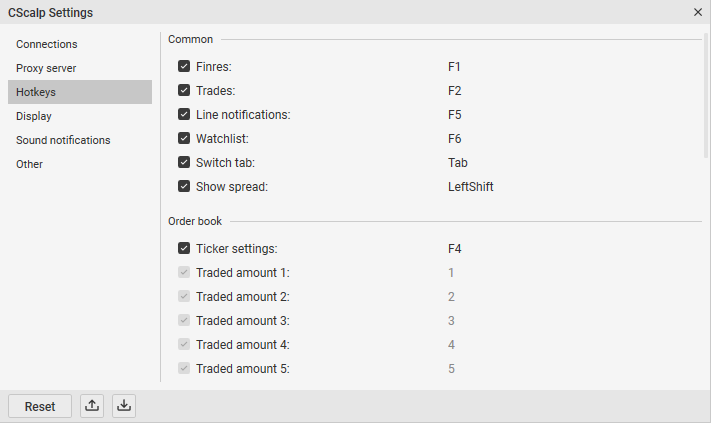
Tab configuration of hotkeys is related to the tabs. It works on basically active tabs and also works on all order books which are opened in this tab. Detailed description of “tab” hotkeys
Settings order book are related only to significant order books (on which you have put a mouse cursor). Detailed description of “market view” hotkeys
How to change
For changing the selected hotkey, click on the set value. Then press the button on the keyboard that you want to make hot for this manipulation.
If the hotkey value is not indicated, that means the hotkey is not assigned and not used.
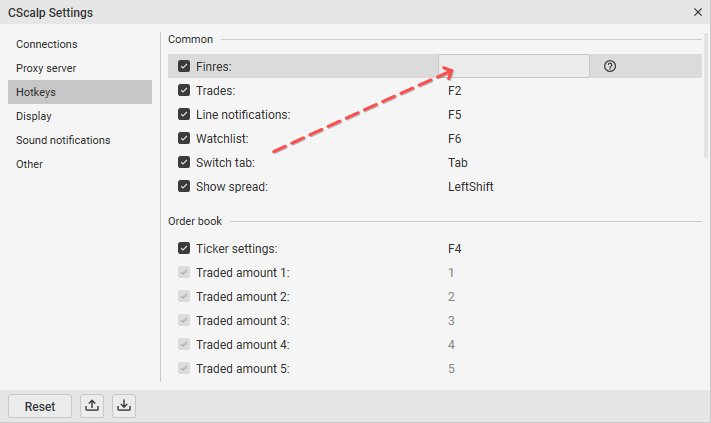
Note: hotkeys work with any keyboard layout.
How to enable or disable
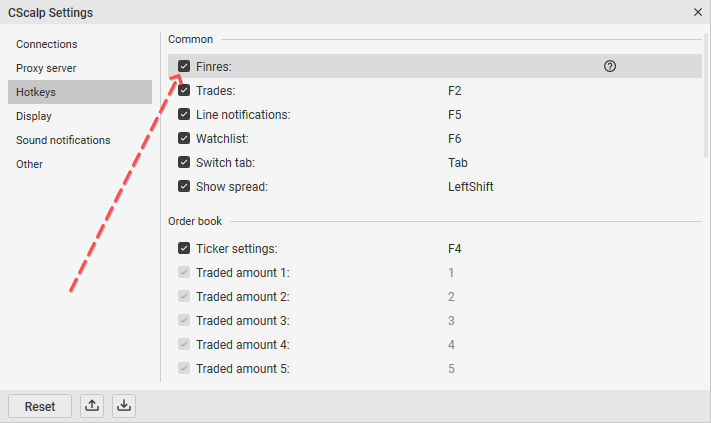
To enable a particular hotkey, select a tick next to the name. The hotkey remains inactive if nothing is happening when you press the set value on the keyboard. After selecting the “tick” CScalp will again react to the hot key command.
Common
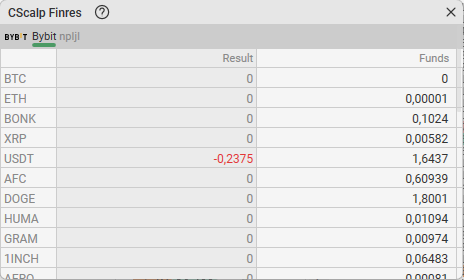
Finres
Default hotkey: “F1”.
This key opens the “Finres” window. This window displays the financial result of all the trader’s trades for the current trading session.
Trades
Default hotkey: “F2”.
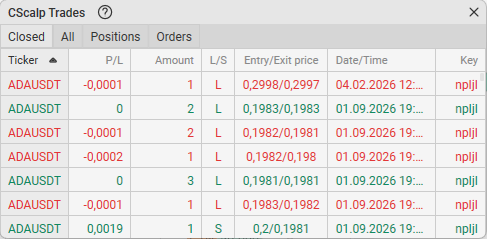
This key opens the “Trades” window. This window displays data on all trades executed by the trader during the current trading session.
Line notifications
Default hotkey: “F5”.
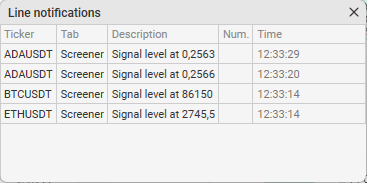
The key opens the “Line notifications” window. This window contains the notifications the trader has configured to receive.
Switch tab
Default hotkey: “Tab”.
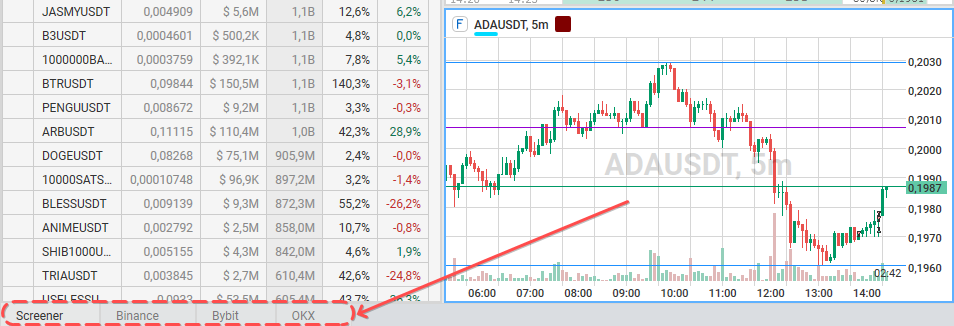
This key allows you to quickly switch between multiple open CScalp tabs. To switch back to the previous tab, press “Shift+Tab”.
Spread centering
Default hotkey: “Left Shift.”.
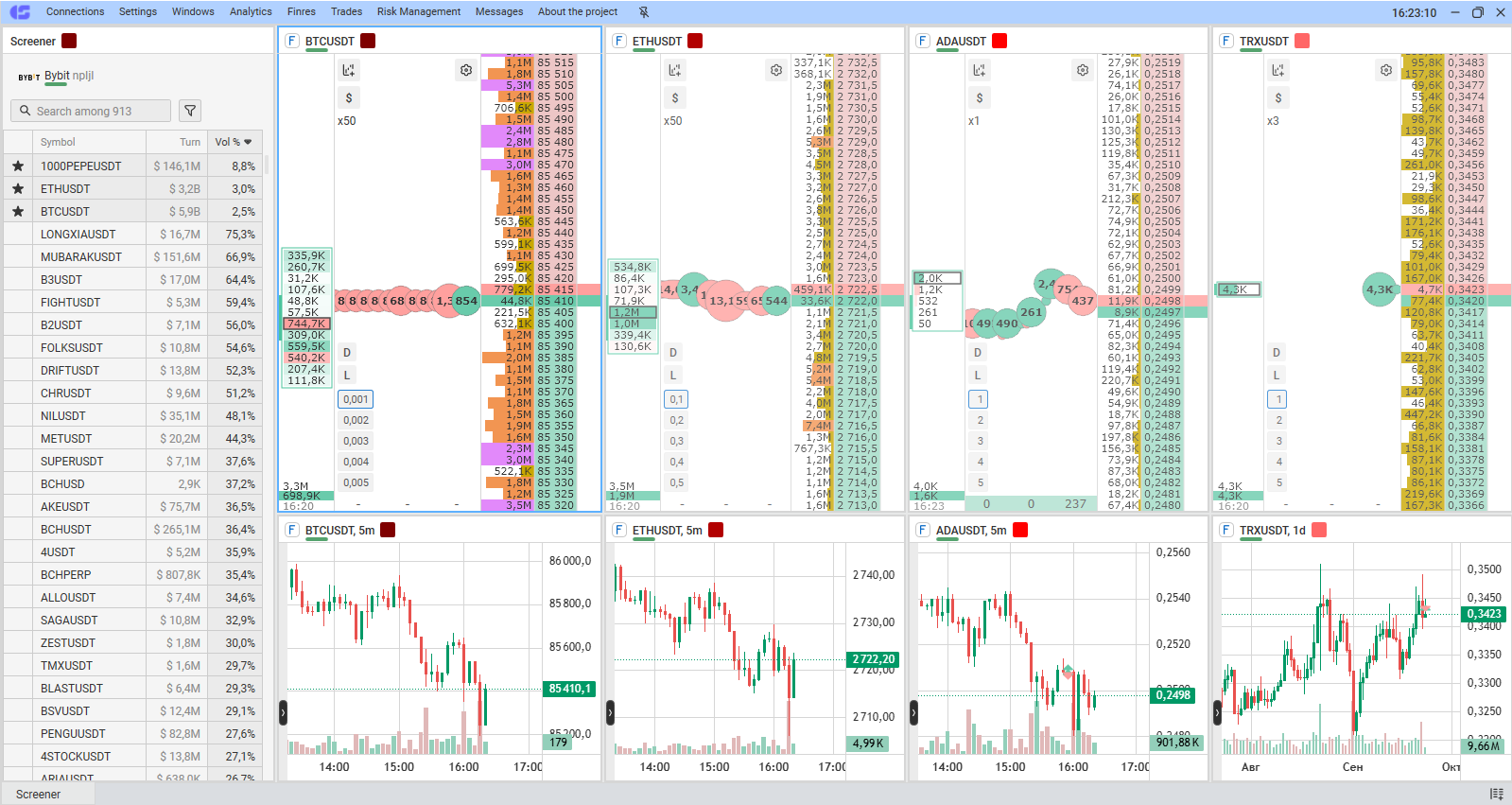
This key allows you to center the spread across all order books on the tab. To activate it, hover your cursor over the corresponding key and press the left Shift key.
Orderbook (common)
Close the position at the market price
Default hotkey: “Left Ctrl”.
This key closes all positions and cancels all limit orders across all order books and tabs. Positions are closed at the market price.
Cancel limit orders
Default hotkey: “Space”.
The key cancels all limit orders across all order books and tabs.
Cancel stop orders
Default hotkey: “Right Alt”.
The key cancels all stop orders across all tabs.
Orderbook
Tool Settings
Default hotkey: “F4”.
This key opens the order book settings window. For the key to work, hover your cursor over the order book (the trade feed, clusters, and charts are not considered part of the order book).
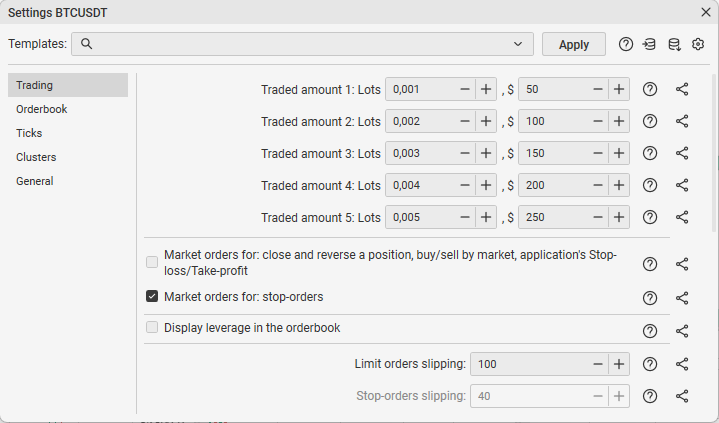
Traded amounts
Default hotkey: «1», «2», «3», «4», «5».
The keys allow you to switch between the trader’s traded amounts.
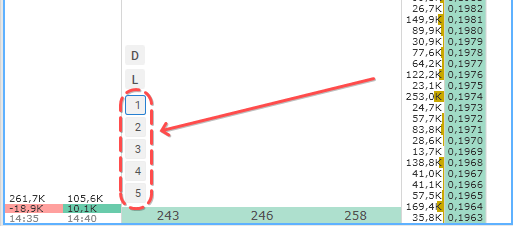
Hotkeys for switching volumes do not work on the Numpad. These keys cannot be remapped or disabled.
Position traded amounts (lots/$)
Default hotkey: “М”.
This key toggles the volume mode between lots and currency value ($). To use the key, hover your cursor over the order book.
Close the position at the market price
Default hotkey: “D”.
This key closes all positions and cancels all limit orders in the active order book. To activate the key, hover your cursor over the order book.
Cancel limit orders
Default hotkey: “F”.
This key cancels all limit orders in the active order book. To use the key, hover your cursor over the order book.
Cancel stop orders
Default hotkey: “B”.
This key cancels all stop orders in the active order book. To use the key, hover your cursor over the order book.
Submit a limit order at the best bid/ask price
Default hotkey: “А/S”.
This key submits a limit buy or sell order at a price one step better than the current best market bid or ask price. To use the key, hover your cursor over the order book.
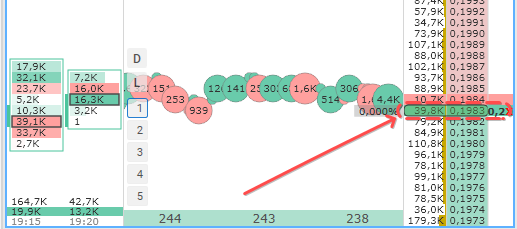
Buy at market price
Default hotkey: “T”.
The key submits a market buy order. To activate the key, hover your cursor over the order book. The purchase will be executed based on the volume active in the order book at the moment the key is pressed.
Sell at market price
Default hotkey: “Y”.
The key submits a market sell order. To activate the key, hover your cursor over the order book. The sale will be executed based on the volume active in the order book at the moment the key is pressed.
Reversing the market position
Default hotkey: “R”.
This key closes the position by sending a market order of double the volume to “flip” the position. To activate the key, hover your cursor over the order book.
Here is an example: suppose we have an open long position of 10 lots. If we press “R,” the terminal will send a market order to sell 20 lots. The 10-lot long position will close, and a 10-lot short position will open. The same applies if we initially held a short position.
Interrupt the execution of trading commands
Default hotkey: “Q”.
This key cancels all trading commands in the active order book. To use the key, hover your cursor over the order book.
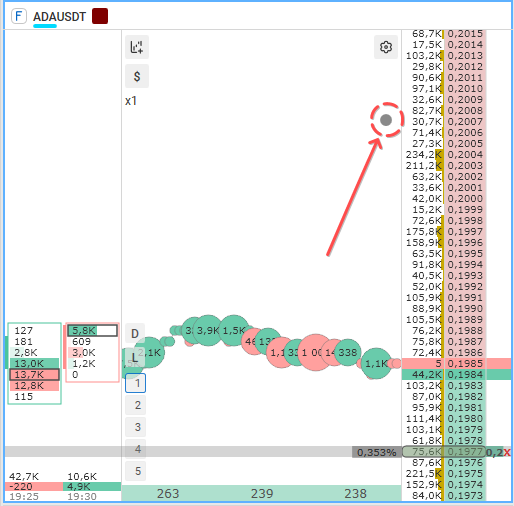
This key is useful during periods of high market volatility. High volatility often leads traders to submit numerous trading commands. Sometimes, a command may take a long time to process; while a command is being executed, other orders cannot be sent to the order book. The “Q” key solves this problem.
Mode: Stop-loss/Take-profit setting
Default hotkey: “С”.
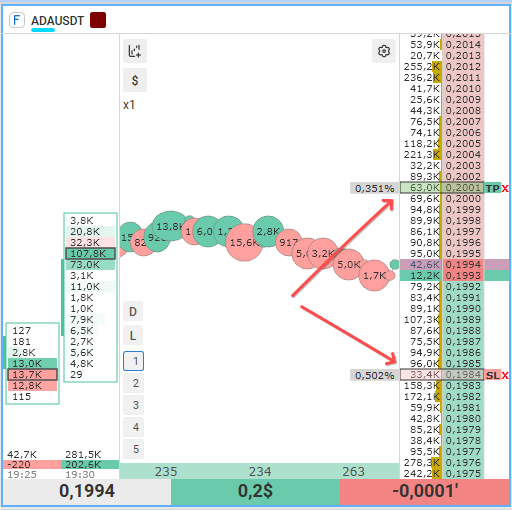
This key sets Stop-Loss and Take-Profit orders. To set SL/TP, hover your cursor over the order book, hold down the “C” key, and click on the desired price level. SL/TP orders can only be set when there is an open position.
Enable/disable trailing for Stop-loss
Default hotkey: “N”.
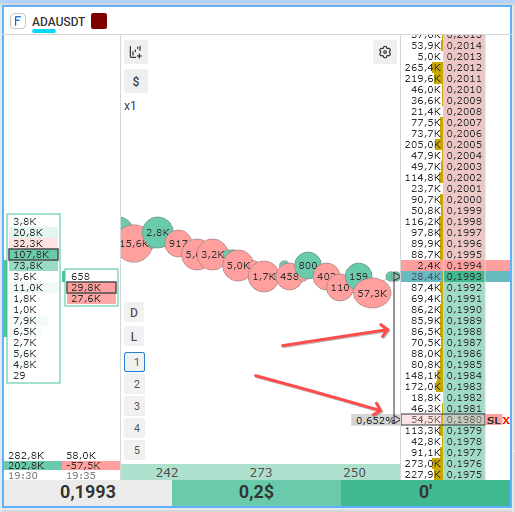
How it works: If you set the Stop-Loss (SL) manually, press the “N” hotkey to activate the trailing function. If you have automatic SL configured, simply preset the SL and Trailing Stop (TS) parameters in the trading instrument settings. When you open a position, a Stop-Loss with the trailing option will be set automatically; the Trailing Stop maintains a set distance between the Stop-Loss and the best price, moving the SL by the specified number of points (in price steps or percentages).
Mode: stop order placement
Default hotkey: “V”.
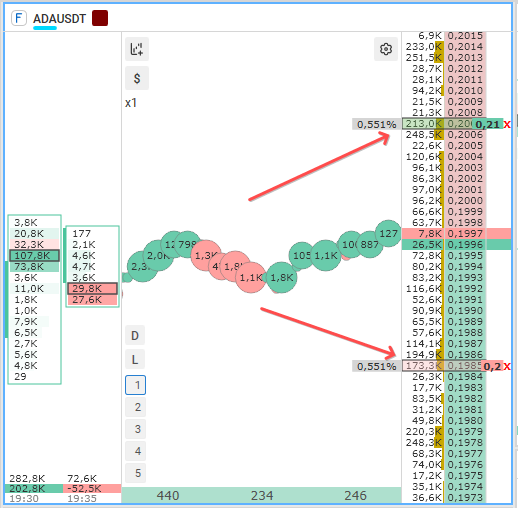
This key places pending orders. To place stop orders, hover your cursor over the order book and press “V”.
Mode: Application for closing 1
Default hotkey: “Left Alt”.
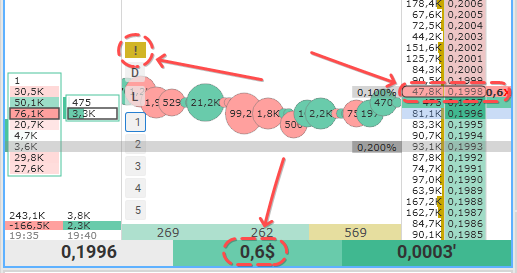
This key creates a position-closing order. Hover your cursor over the order book, hold down the “Left Alt” key, and click on the desired price level. The terminal will create a closing order with a volume equal to that of the open position (regardless of the volume currently selected in the order book).
Mode: Application for closing 2
Default hotkey: “Z”.
This key creates a position-closing order. Hover your cursor over the order book, press “Z,” and click on the desired price. The terminal will create an order to close the position with a volume equal to that of the position itself (regardless of the volume selected in the order book).
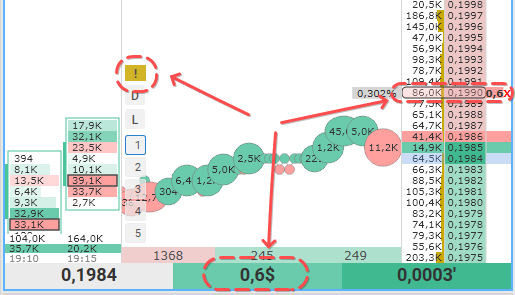
Mode: first volume at market price
Default hotkey: “X”.
This key allows you to place a buy order using the volume of the first seller or the first buyer. Hover your cursor over the order book, press “X,” and click on the desired price level. Left-clicking places a buy order using the first seller’s volume; right-clicking places a sell order using the first buyer’s volume.
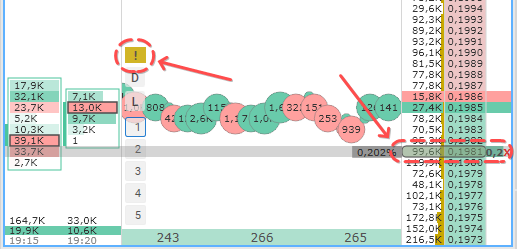
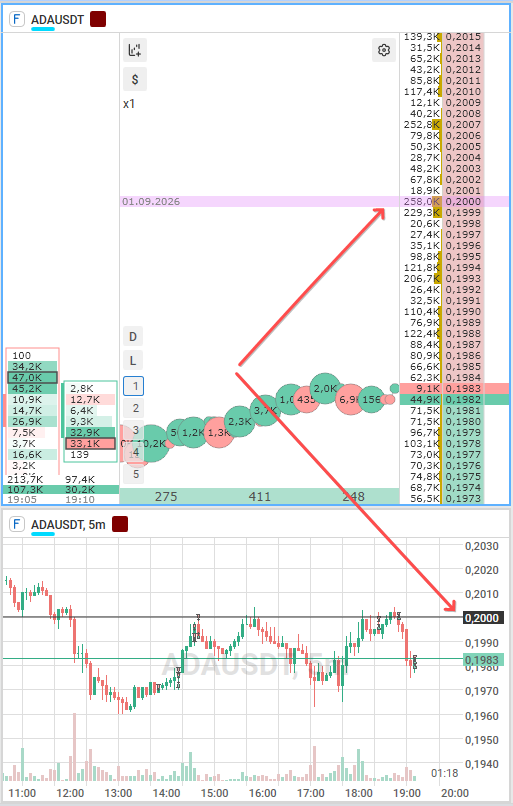
Mode: level setting
Default hotkey: “L”.
This key sets a level in the order book. To set a level, hover your cursor over the order book and hold down the “L” key; a “Level” message will appear. Click on the desired price. Once the price level is set, the date it was established will be displayed.
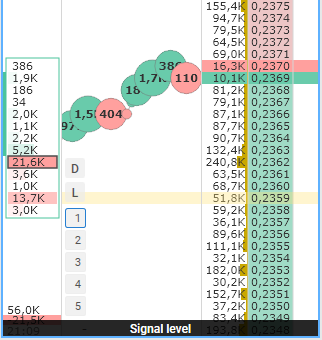
Mode: setting the signal level
Default hotkey: “К”.
This key sets an alert level in the order book. To set an alert level, hover your cursor over the order book and press “K”; an “Alert level” message will appear. Click on the desired price. When the price crosses the alert level, you will receive an audio notification (provided audio notifications are enabled in the settings). The time at which the price crossed the level will appear at that price point.
Delete all levels
Default hotkey: “О”.
This key removes all levels set on the order book and the chart. To delete the levels, hover your cursor over the order book and press “O”.
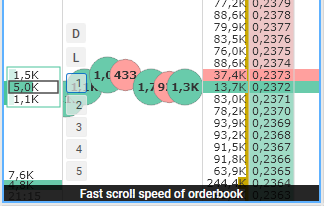
Mode: accelerated order book scrolling
Default hotkey: “~”.
This key accelerates the scrolling of the order book by the number of ticks specified in the instrument settings. Hover your cursor over the order book, press and hold the “~” key, and scroll using the mouse wheel. Without the hotkey, a single mouse wheel movement scrolls the order book by 10 price steps; with the hotkey, it scrolls by the value specified by the trader.
Mode: price step change
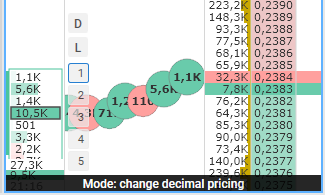
Default hotkey: “Н”.
This key allows you to smoothly adjust the price step using the mouse wheel. Hover your cursor over the order book, hold down the “H” key, and scroll the order book with the mouse wheel.
Increase / decrease price step
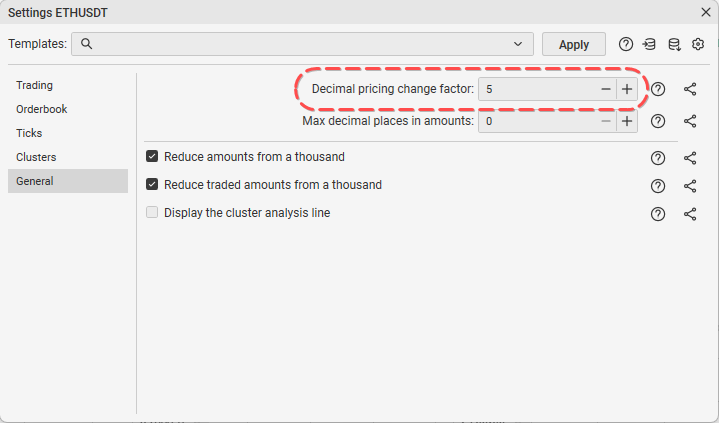
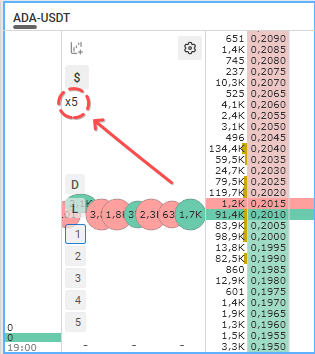
For certain instruments, when the order book is “uncompressed,” the price moves rapidly, and many price levels appear empty (showing no volume). To make the display easier to read, you can adjust the price step. For example, applying a 10x scale would turn a 1-cent increment into 10 cents. You can configure this price step setting in the instrument’s options.
Default hotkey: “+ / -“.
This key allows you to increase or decrease the instrument’s price step. In the instrument settings (under the “General” tab, in the “Price Step Multiplier” field), set a value that will be automatically multiplied by 10. For example, if you set the value to 3, pressing the hotkey will increase or decrease the price step by a factor of 30. Hover your cursor over the order book and press “+” or “-“.
Order book volume mode (lots/currency)
Default hotkey: “E”.
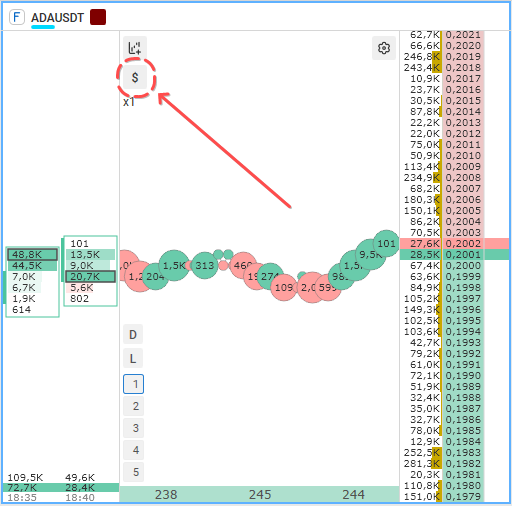
This key allows you to toggle the volume display mode in the order book between “lots” and “currency,” though it does not change the actual trading volumes. The active mode is displayed in the top-left corner of the order book: “L” indicates “lots” mode, while “$” indicates “currency” mode.
Hover your cursor over the order book and press “E”.
Mode: manual ruler
Default hotkey: “G”.
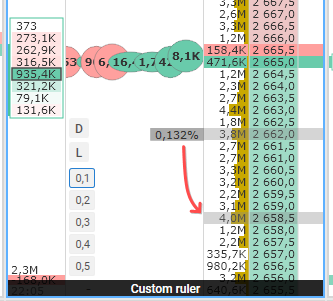
How it works: CScalp allows you to extend a ruler from a chosen price level to a specific point in the order book and calculate changes in terms of percentage, points, price, or volume.
Hover your cursor over the order book and press the hotkey. A reference point will appear next to the price. Drag the ruler to the target price to see the change in points, volume, price, or percentage.
Enable/disable date market server
Default hotkey: “P”.
How it works: CScalp allows you to enable/disable market data in connections for proprietary companies trading on the Moscow Exchange.
Hover your cursor over the order book and press the hotkey to enable/disable market data. Market data allows you to increase the depth of the order book on the Moscow Exchange.
How to change: To change the hotkey value, click the button with the current hotkey value. Then press the key you want to make the hotkey. If the key is not assigned, the hotkey value will change. If the key is assigned, the value will revert to the default value.
Note: Works with any keyboard layout.
How to enable/disable: The hotkey is active when the checkbox next to the hotkey is selected. To enable/disable the hotkey, check/uncheck the checkbox. If the hotkey value is not written on the button, then the hotkey is not assigned and is not used.
Enable/disable date market server (all connections)
The default key is not assigned.
How it works: CScalp also allows you to enable/disable market data for all connections of prop companies trading on the Moscow Exchange.
Hover your cursor over the order book and press the hotkey to enable/disable market data. Market data allows you to increase the depth of the order book on the Moscow Exchange.
How to change: To change the hotkey value, click the button with the current hotkey value. Then press the key you want to make the hotkey. If the key is not assigned, the hotkey value will change. If the key is assigned, the value will revert to the default value.
Note: Works with any keyboard layout.
How to enable/disable: The hotkey is active when the checkbox next to the hotkey is selected. To enable/disable the hotkey, check/uncheck the checkbox. If the hotkey value is not written on the button, then the hotkey is not assigned and is not used.
Function “Expand/collapse glass/chart”
Default hotkey: “J”.
How it works: Expands the active chart or order book to full screen.
Switch to Next Futures
Default hotkey: “PageUp”.
How it works: Switches the order book to the new futures contract for the selected instrument.
Switch to Previous Futures
Default hotkey: “PageDown”.
How it works: Switches the order book to the old futures contract for the selected instrument.
Download CScalp if you haven’t downloaded it yet
You can download CScalp using the form below. Enter your e-mail address in the field. The letter containing an unlimited license key, installation file and video manual of the terminal’s installation in a few minutes.GET FOR FREE
Join the CScalp Trading Community
Join our official trader's chat. Here you can communicate with other scalpers, find trading soulmates and discuss the market. We also have an exclusive chat for crypto traders!
Don't forget to subscribe to our official CScalp news channel, use trading signals and get to know our bot.
If you have any questions, contact our support team: support@in.fsr-develop.com.
You can also subscribe to the CScalp TV YouTube channel.
JOIN OUR CHAT